Space Courier
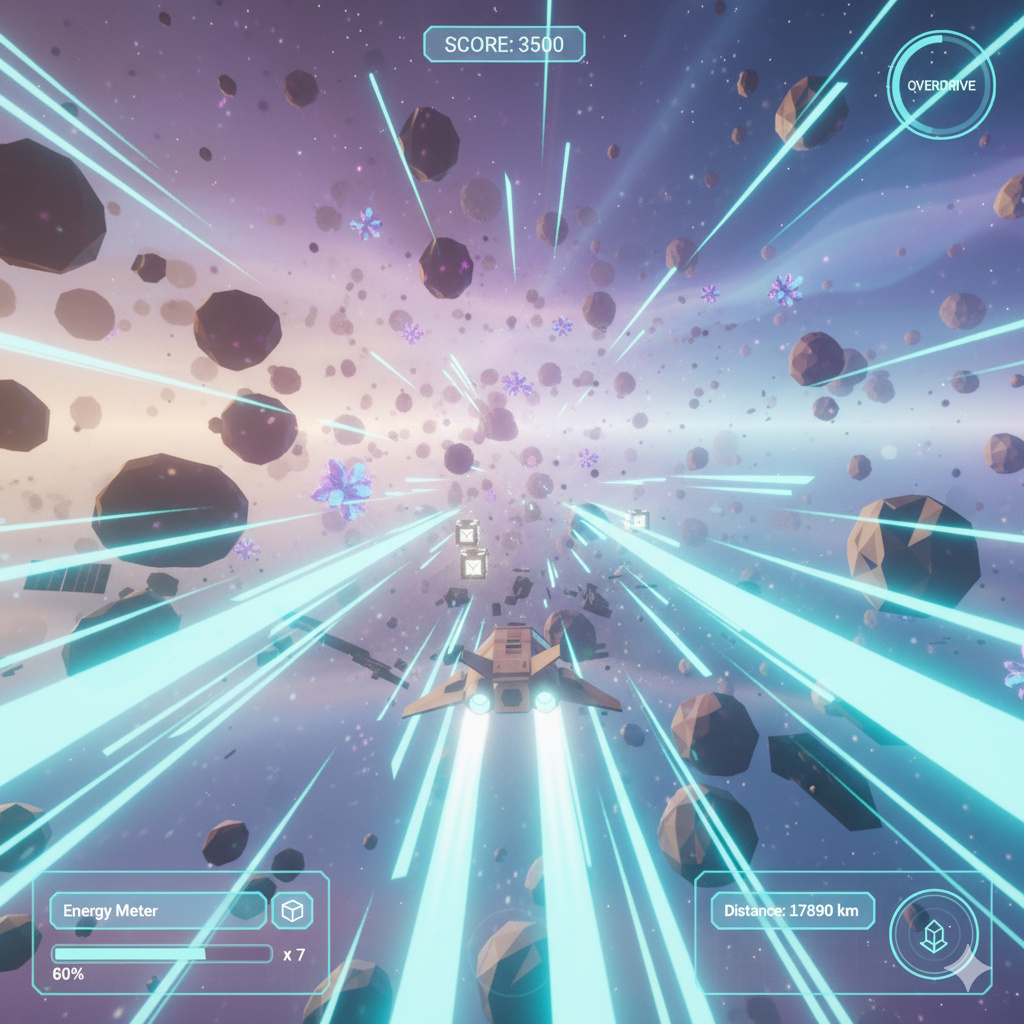
Space Glider
Space Glider started as a simple hyper-casual mobile game: control a spaceship, avoid obstacles, survive as long as possible, and chase a higher score.
At first, the project was deliberately small. The goal was not to build a huge space game or a complicated progression system. It was an experiment in creating a fast, accessible gameplay loop that could be understood within seconds and played in short sessions.
What started as a straightforward mobile prototype eventually became something much larger. The first MVP was completed and released on Myket, but development was interrupted when I began my military service. The project was put on hold before I could take it further.
Now I have returned to Space Glider with a different goal: polish the original game, finish the systems that were left behind, and prepare it for multiple platforms, including Android, Google Play, PC, and WebGL through itch.io.
The Original Idea
The original concept was built around an extremely simple gameplay loop.
The spaceship automatically moves forward through space while the player controls its vertical movement. Tapping the screen makes the spaceship descend briefly, allowing the player to avoid incoming obstacles.
There are no complicated controls to learn. The player simply needs to understand one thing:
Stay alive.
Asteroids and space debris appear in the player's path, and the game gradually becomes more difficult as the speed and density of obstacles increase.
The longer the player survives, the higher the score becomes.
Building the First Prototype
The first stage of development focused entirely on proving that the core gameplay loop worked.
I implemented the basic spaceship movement, automatic forward motion, obstacle spawning, collision detection, touch controls, and scoring system.
The initial prototype used placeholder obstacles and simple visual elements. At this stage, presentation was not important. I wanted to answer a much more important question:
Is controlling the spaceship actually fun?
Once the basic movement was working, I began experimenting with the responsiveness of the controls and the way obstacles were generated.
The spaceship needed to feel predictable enough for the player to understand its movement, while still requiring enough attention to make avoiding obstacles satisfying.
One-Tap Controls
The control system was intentionally kept extremely simple.
The spaceship continuously glides forward, and tapping the screen temporarily changes its vertical movement. This creates a simple rhythm where the player constantly watches the upcoming path and makes small corrections to avoid collisions.
There is no virtual joystick, complicated button layout, or combination of inputs.
Just one input.
This made the game particularly suitable for mobile devices, where a player should be able to start playing almost immediately.
Increasing the Difficulty
An endless game needs a reason to keep pushing the player.
For Space Glider, that reason is a gradually increasing difficulty curve.
As the player survives longer, obstacles become faster and more densely distributed. The game begins relatively calmly, giving the player time to understand the movement, and gradually becomes more demanding.
The difficulty system was implemented as an algorithm rather than a collection of completely separate levels. This allows the game to continuously increase the challenge during a single run.
The result is an endless gameplay loop where every additional second of survival becomes increasingly valuable.
Scoring and High Scores
The scoring system was another important part of the MVP.
The player's current score is tracked during the run and displayed during gameplay. When the player crashes, the final result can be compared against the previously achieved high score.
The high score is stored locally so that every new game has a simple objective:
Beat your previous record.
This creates the classic hyper-casual loop of:
Play → Crash → Try Again → Beat Your Score.
Adding Progression
After the core gameplay was working, I started building a lightweight progression system around it.
Players can collect points and power-ups during gameplay. These resources can then be used to unlock additional spaceship skins and cosmetic content.
The intention was to give players something to work toward without turning the game into a complicated progression-heavy experience.
The gameplay remains simple, while the surrounding systems give players additional reasons to keep playing.
The In-Game Store
I implemented an in-game store where players can browse available spaceship skins and cosmetic upgrades.
The store includes item previews, prices, and the necessary systems for connecting purchases to the player's collected resources.
This was also an opportunity to build a more complete game UI rather than treating the project as nothing more than a gameplay prototype.
The progression system, store, scoring system, and gameplay loop were designed to work together:
- Play the game.
- Survive longer.
- Collect points and power-ups.
- Improve your score.
- Unlock new ships and cosmetics.
- Play again.
Monetization
The original mobile version was also designed with a traditional free-to-play hyper-casual model in mind.
Advertisements could appear between gameplay sessions or when the player chooses to continue after crashing.
The game also included plans for optional purchases such as additional cosmetic content and an ad-removal option.
For the original Iranian Android release, I integrated Tapsell for advertising and designed the monetization system around Cafe Bazaar and Myket.
The goal was to keep monetization separate from the core gameplay itself. The player should still be able to play the game normally without needing to purchase anything.
The First MVP
Eventually, the first playable version of Space Glider reached the point where it could be considered an MVP.
The core gameplay was implemented. The obstacle generation worked. Difficulty increased over time. Scoring and high scores were functional. Unlockable content and the store had been implemented, and the mobile-specific systems were being integrated around the game.
Most importantly, I actually released the MVP.
Space Glider was launched on Myket.
That release was an important milestone because it moved the project from being another prototype sitting on my computer to being an actual published game.
Then Military Service Happened
Unfortunately, the timing of the project coincided with my military service.
I had to stop development and could not continue polishing the game, improving the content, analyzing its performance, or properly expanding its release.
Space Glider was essentially frozen at the point where I had to leave it.
That meant the project remained in an unusual state: it was already a functional and released mobile game, but it was also clearly not the final version I wanted to make.
Coming Back to the Project
After returning to development, I decided not to throw the project away.
Instead, I looked at Space Glider as an existing foundation that could be expanded beyond its original mobile MVP.
The original version was designed primarily around the Iranian mobile market. The new version can be treated as a broader release.
My current goal is to polish the existing game and prepare it for:
- Android
- Google Play
- PC
- WebGL
- itch.io
This changes the project considerably.
Instead of thinking about Space Glider as a mobile-only hyper-casual experiment, I can now use the existing foundation to create a small multi-platform game.
Building My Own Account and Cloud Save System
One of the biggest technical additions came from another area of my development experience: backend programming.
I wanted Space Glider to have a proper account and cloud-save system, but I did not want to make the game dependent on a third-party service for something I could build myself.
Using my experience with ASP.NET Core and .NET backend development, I built my own backend infrastructure for accounts and game data.
The game now has systems for:
- Account creation and authentication
- Saving player progression
- Loading player data
- Cloud saves
- Synchronizing player progress with the backend
- Persisting unlocks and other game data
This means the game is no longer limited to storing everything exclusively on the player's device.
The same backend approach can also support multiple platforms. A player can have an account containing their progression rather than having their entire game state tied to a single installation.
This part of the project was particularly interesting to me because Space Glider started as a tiny hyper-casual game, yet it eventually became a practical demonstration of my full-stack development skills as well.
From Game Development to Full-Stack Development
One of the interesting things about Space Glider is how many different areas of development ended up meeting inside a very small project.
The game itself requires the usual game-development systems: movement, collision detection, procedural obstacle generation, difficulty scaling, scoring, UI, progression, and input handling.
But once I decided to support accounts and cloud saves, the project also became a backend engineering exercise.
I had to think about data models, authentication, persistence, API communication, saving and loading, synchronization, and how the game client interacts with a remote service.
Because I already work with .NET, I was able to build this infrastructure myself rather than relying entirely on an external game backend.
That makes Space Glider useful to me beyond the game itself. It became another project where I could combine my game-development and software-engineering experience.
Preparing for PC and WebGL
The next stage is taking Space Glider beyond its original mobile release.
The core gameplay is simple enough to translate naturally to other platforms.
On mobile, the primary input is touch. On PC, the same concept can be mapped to keyboard or mouse input. The WebGL version can provide another lightweight way for players to access the game directly through a browser.
The planned WebGL release on itch.io is particularly interesting because it gives the project a place where players can immediately try the game without installing a mobile application.
The PC version also gives the project another opportunity to exist as a standalone small game rather than being restricted to the hyper-casual mobile market.
Development as an Experiment
Looking back at the project, Space Glider is much more than an endless spaceship game.
It started as an experiment in creating a very small gameplay loop.
Then it became an experiment in progression and monetization.
Then it became a published mobile MVP.
After that, it became a project interrupted by circumstances outside development.
Now it has become an experiment in taking an existing game and extending it into a multi-platform project with its own backend infrastructure.
That evolution is one of the most interesting parts of the project.
What I Learned
Space Glider taught me that even a very small game can contain a surprising amount of engineering.
The original gameplay is intentionally simple, but building the complete product around that gameplay requires many different systems.
I worked on:
- Player movement and controls
- Procedural obstacle generation
- Collision detection
- Dynamic difficulty scaling
- Scoring and high scores
- Power-ups and collectible resources
- Unlockable spaceship skins
- In-game store systems
- Mobile monetization
- Android publishing
- Account management
- Cloud saving
- Backend APIs
- Local and remote persistence
- Cross-platform preparation
It also reinforced something I have learned repeatedly while making games: finishing and releasing a small project can teach more than endlessly expanding an unfinished one.
What Comes Next
The original MVP is already a part of Space Glider's history.
Now I want to take the project further.
The immediate goal is to polish the existing game, make sure the account and cloud-save systems are reliable, improve the overall presentation, and prepare the project for a wider release.
The next releases are planned around Google Play, PC, and WebGL through itch.io.
There is still work to do: testing different platforms, improving UI and presentation, checking performance, polishing the gameplay loop, and making sure the backend behaves reliably under real-world conditions.
But unlike the original development period, I now have a completed foundation to build upon.
Final Thoughts
Space Glider began with one simple idea:
How long can you survive in space?
It became a small hyper-casual mobile game, reached its first MVP, and was released on Myket before military service forced development to stop.
Now the project is coming back.
The goal is no longer only to make a quick mobile game. It is to take that original prototype, polish it, expand its technical foundation, and release it across multiple platforms.
From a one-tap spaceship game to a multi-platform project with its own account and cloud-save infrastructure, Space Glider has grown considerably beyond its original scope.
And this time, I'm taking it all the way to release.