How i created Space Courier
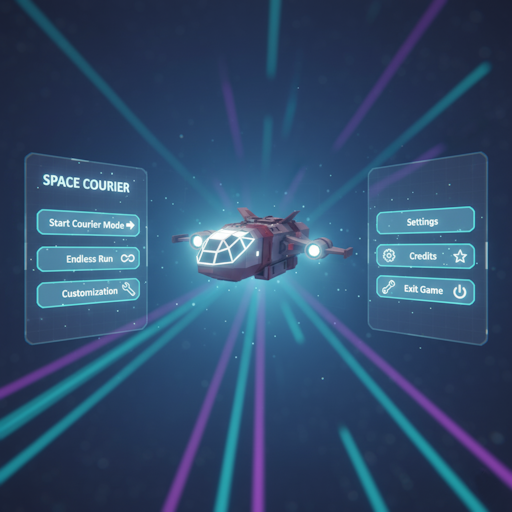
How I Created Space Courier
When I set out to make Space Courier, I wanted to create something simple, fun, and instantly addictive. I’ve always admired hyper-casual games—the kind you can play in short bursts while waiting for the bus, yet still find yourself coming back to again and again. That was my starting point.
The Core Idea
The concept behind Space Courier was straightforward:
-
A spaceship gliding endlessly through space
-
A one-tap control system that anyone can pick up instantly
-
Increasingly challenging obstacles that keep you on edge
The magic of hyper-casual design lies in stripping everything down to the essentials. No complex tutorials, no cluttered UI—just the player, the spaceship, and space itself.
Building the Core Gameplay
The first milestone was prototyping the ship’s movement and the obstacle system. I wanted the spaceship to feel responsive yet smooth, so I went with automatic forward gliding and a tap-to-descend mechanic.
It took a few days to get the feel right. Too floaty, and it felt unresponsive. Too heavy, and it wasn’t fun. Once I nailed the controls, I added:
-
Randomly generated asteroids and debris
-
Collision detection
-
A scoring system to keep players chasing their high score
At this stage, the game was already playable and surprisingly addictive.
Adding Progression
Endless games need that little “carrot on a stick” to keep players engaged. For Space Courier, that meant:
-
Collectible points and power-ups
-
Unlockable spaceship skins and cosmetic upgrades
-
A simple in-game store to browse them
I kept everything cosmetic, so the gameplay remained fair—just skill, no pay-to-win.
Monetization (Keeping It Fair)
Hyper-casual games live off of ads and in-app purchases. I integrated ads using Tapsell, showing them only between sessions or when players choose to continue after a crash.
For players who want a cleaner experience, I added the option to remove ads through in-app purchases, along with premium skins. The goal was balance: monetize without breaking the flow of fun.
The Iteration Process
I believe the secret to polish is iteration. I conducted several playtesting rounds with friends and community members, gathering feedback on:
-
Controls (too sensitive? too slow?)
-
Difficulty progression (fair or frustrating?)
-
Performance on different devices
Every test led to small adjustments—speed tweaks, obstacle frequency balancing, UI refinements. Over time, the game became more accessible yet challenging enough to hook players.
Marketing & Launch
For launch, I focused on:
-
App store optimization: catchy title, strong keywords, polished screenshots, and a trailer
-
Social media teasers: short clips showing gameplay
-
Collaborations: reaching out to mobile game influencers for early previews
-
Cross-promotion: connecting with other devs in the hyper-casual space to share audiences
I released Space Courier on Cafe Bazaar and Myket, and I continue to monitor feedback and push updates.
Lessons Learned
Building Space Courier reminded me that even the simplest ideas take a lot of refinement. A one-tap control mechanic may seem easy, but it lives or dies on responsiveness and feel. Likewise, progression and monetization require balance—you want players to feel rewarded, not exploited.
Most importantly, I realized that creating a hyper-casual game is like crafting a puzzle with only a few pieces. You don’t have the luxury of complexity—so every single element has to matter.
Conclusion
Space Courier isn’t just a game—it’s my experiment in simplicity, challenge, and engagement. It taught me how to balance design, monetization, and player experience in a tight development cycle.
And for me, that’s the beauty of indie development: turning small ideas into games that people around the world can enjoy in their daily lives.