Sector 4
Sector 4
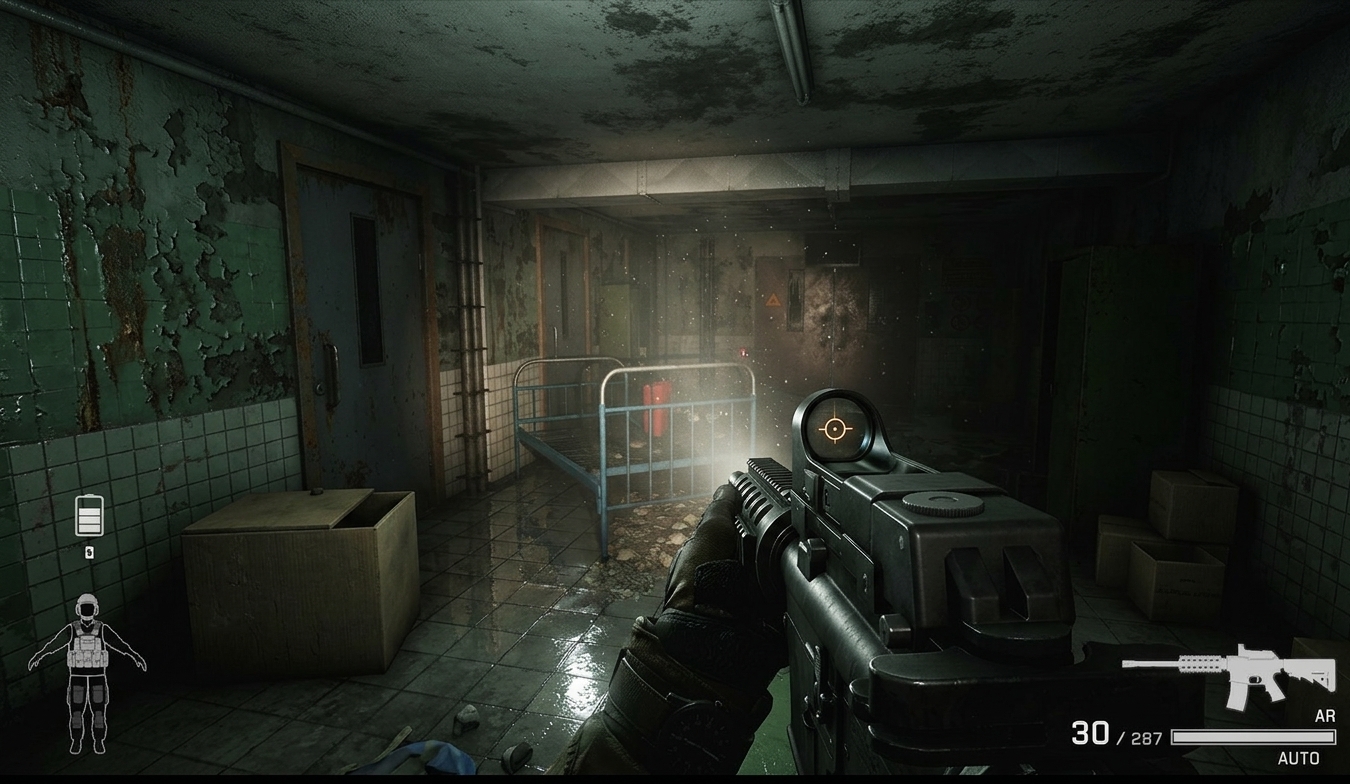
Sector 4 is a first-person action survival horror game set deep beneath the ruins of an abandoned Soviet underground facility.
A team of U.S. Marines is sent to investigate the facility after contact with the site is lost. What begins as a routine military investigation quickly turns into a fight for survival when the team discovers that the underground complex is not as abandoned as it first appeared.
Something is still moving in the darkness.
Deep below the surface, the facility has become a maze of forgotten corridors, sealed rooms, damaged infrastructure, abandoned equipment, and hostile creatures. The deeper the player goes, the more difficult it becomes to determine what happened to the people who once occupied the facility — and what is now living inside it.
Sector 4 combines first-person combat, exploration, environmental storytelling, resource management, and survival horror into a compact single-player experience.
Into the Underground
The player enters Sector 4 with a simple objective: investigate the abandoned facility and find a way through it.
Very quickly, that objective becomes something much more difficult.
The underground complex is not a straightforward corridor from one location to another. Doors are locked. Power systems have failed. Security systems remain active in parts of the facility. Important areas are inaccessible until the player restores the infrastructure required to reach them.
Progress therefore comes from exploration as much as combat.
The player must search rooms, investigate the environment, find keys and access points, restore systems, activate equipment, and determine how different parts of the facility connect together.
Every new area can reveal another part of the facility — or another threat waiting in the darkness.
A Facility Without Power
One of the central elements of Sector 4 is the condition of the underground facility itself.
Much of the complex has been left without reliable power.
Corridors disappear into darkness.
Doors refuse to open.
Machines sit inactive.
Security systems operate only partially.
Emergency lighting provides only limited visibility.
The player cannot simply walk through the facility and expect every system to work.
Restoring power becomes an important part of progressing through the underground complex.
Bringing the Facility Back to Life
Restoring electricity is more than a simple objective marker.
The player must investigate the facility and interact with its infrastructure to bring important systems back online.
Power can determine which doors can be opened, which sections of the facility can be accessed, and which systems become available.
A dark section of the facility can change completely once electricity is restored.
Lights come back online.
Machines begin operating.
Security systems can become active.
Previously inaccessible areas can become reachable.
But restoring power also means restoring parts of a facility that may have been silent for years.
Turning the lights back on does not necessarily make the underground complex safer.
Sometimes it simply makes it easier to see what is already there.
Light Is a Resource
Darkness is one of the most important environmental elements in Sector 4.
The player carries equipment that allows them to see in areas where the facility's lighting has failed, but that equipment is not an unlimited solution.
The flashlight requires batteries.
Those batteries run down.
And when the batteries are gone, the player has to make decisions.
Do you continue moving through the darkness?
Do you conserve the remaining battery?
Do you switch to another piece of equipment?
Do you search the environment for another source of power or supplies?
Light therefore becomes part of the survival system rather than simply a visual effect.
Flashlight
The flashlight provides direct illumination in dark areas and makes exploration considerably easier.
However, using it continuously comes with a cost.
The battery gradually runs down, forcing the player to pay attention to how and when they use it.
A player who keeps the flashlight running throughout the entire facility may find themselves without enough power when they need it most.
This creates a simple but important survival decision:
Do you use your light now, or save it for later?
Night Vision
When conventional lighting is unavailable, the player can use night vision equipment to navigate the underground facility.
Night vision changes the way the environment is perceived.
Instead of relying entirely on the flashlight, the player can navigate areas that would otherwise be almost completely dark.
But night vision is not intended to eliminate the importance of darkness.
It is another tool.
The player must decide which equipment is appropriate for the situation and manage the resources available to them.
Visibility and Vulnerability
Darkness affects more than what the player can see.
Limited visibility creates uncertainty.
A corridor can appear empty until something moves inside it.
A doorway can hide an enemy.
A room that looks safe from a distance may contain something waiting just outside the player's immediate field of view.
The player is therefore encouraged to move carefully through unfamiliar areas while constantly interpreting what they can see and hear.
The environment itself becomes part of the threat.
Weapons
Sector 4 is an action survival horror game, so combat is an important part of the experience.
The player has access to firearms that can be used to defend themselves against the creatures inhabiting the facility.
Weapons are not simply decorative equipment. They are an essential part of surviving encounters with hostile creatures and zombies.
Combat is designed around direct first-person control, requiring the player to aim, react, manage their position, and decide when engaging an enemy is worth the resources it consumes.
Weapon Customization
The weapon system also provides room for customization and experimentation.
Players can modify and configure their weapons to better suit the situations they encounter inside the facility.
This gives the combat system an additional layer beyond simply finding a weapon and using it exactly as it was discovered.
Weapon customization allows the player to develop equipment that fits their preferred approach to combat while maintaining the game's focus on exploration and survival.
The objective is not to turn Sector 4 into a traditional weapon-management simulator. Instead, customization exists as another way for the player to prepare themselves for the increasingly dangerous environment.
Combat in Confined Spaces
The underground environment naturally creates close and uncomfortable combat situations.
Corridors are narrow.
Rooms can have limited visibility.
Doors and infrastructure can restrict movement.
Enemies can appear from unexpected directions.
This means combat is closely connected to exploration.
The player is not fighting inside an isolated arena.
The firefight happens inside the same facility that the player is trying to navigate.
A hallway that was previously used as a safe route can become dangerous after an enemy encounter.
A room that appeared empty may become a place the player needs to revisit.
The environment remains part of the gameplay even after combat begins.
The Infected
The underground facility is inhabited by hostile creatures and zombies.
These enemies are not simply targets placed throughout the level. They are part of what makes the abandoned complex dangerous.
The player must learn to recognize threats, manage encounters, and decide when to fight and when to move.
Different encounters can create different levels of pressure.
A single enemy in a dark corridor can create tension without requiring a large combat sequence.
A group of zombies can turn an otherwise familiar area into a dangerous fight.
The result is a balance between exploration and sudden bursts of action.
Zombies
Zombies are the primary hostile presence within the underground facility.
They provide the direct combat threat while also reinforcing the mystery surrounding what happened inside Sector 4.
The player does not enter an empty abandoned facility.
They enter a facility that has been occupied by something else for a long time.
The deeper the player explores, the more important it becomes to understand where these creatures came from and why the facility was abandoned.
Body-Part Damage
The combat system also incorporates body-part damage, allowing enemies to react differently depending on where they are hit.
This creates more detailed combat interactions than simply treating every enemy as a single health bar.
Targeting different parts of an enemy can influence the encounter and gives the player another layer of control during combat.
Combined with direct first-person aiming, body-part damage makes shooting feel more connected to the physical presence of the enemies rather than simply reducing an abstract health value.
Exploration
Exploration is one of the central pillars of Sector 4.
The underground facility is designed as a place the player has to understand.
Doors, corridors, rooms, security systems, power infrastructure, and objectives create a network that gradually becomes more familiar as the player progresses.
Instead of constantly moving from one combat encounter to another, the player spends time navigating the facility and determining where they need to go next.
This creates a rhythm between exploration and action.
Walk through the darkness.
Investigate the environment.
Find something important.
Restore a system.
Move into a new section.
Encounter the creatures.
Fight.
Then continue deeper underground.
Keys, Doors and Access
Progress through Sector 4 is also tied to the physical infrastructure of the facility.
Locked doors, keys, access points, security systems, and other environmental interactions provide reasons for the player to explore their surroundings rather than simply following a linear corridor.
A key discovered in one area may open a previously inaccessible location.
A restored system may activate another part of the facility.
A security mechanism may reveal a new route.
These interactions turn the environment into a collection of connected problems that the player gradually solves.
Objectives
The player is guided through the facility by a series of objectives.
These objectives provide structure while still allowing exploration to remain an important part of the experience.
An objective may require the player to find a specific item, reach a location, restore power, activate a system, access a restricted area, or continue toward an escape route.
The objective system gives the player a reason to move forward while the environment provides the details required to figure out how to accomplish it.
Security Systems
The facility contains remnants of its original security infrastructure.
Security systems, surveillance equipment, access controls, and other infrastructure contribute to the atmosphere of the complex and provide additional gameplay interactions.
The player can encounter systems that are still operating, systems that have partially failed, and systems that require power or access before they can be used.
This reinforces the feeling that the facility was once a functioning military or industrial environment before being abandoned.
CCTV and Surveillance
Surveillance systems provide another way to interact with the facility.
CCTV systems allow the player to observe parts of the underground complex and gather information about areas they may not have directly explored yet.
Surveillance also reinforces the idea that the player is moving through a facility that was designed to monitor and control movement.
Even after years of abandonment, parts of that infrastructure can remain operational.
Environmental Storytelling
Sector 4 does not rely entirely on traditional exposition to explain its world.
The facility itself is part of the story.
Abandoned equipment, damaged infrastructure, security systems, locked rooms, power failures, surveillance systems, and the condition of the environment provide clues about what happened before the player arrived.
The player discovers the history of the location by moving through it.
The goal is to make the environment feel like a real place that existed before the player entered it.
The Atmosphere of Sector 4
The underground setting allows the game to create a very specific atmosphere.
There is no open horizon.
No sunlight reaches most of the facility.
Long corridors disappear into darkness.
Emergency lights illuminate only parts of the environment.
Mechanical systems may suddenly activate.
Power can fail.
Sounds can travel through empty corridors.
The player is constantly surrounded by the physical remains of the facility.
This creates an environment where even ordinary exploration can feel threatening.
Resource Management
Survival is not only about defeating enemies.
The player must also manage the equipment that allows them to navigate the environment.
Flashlight batteries can run low.
Equipment has limited usefulness.
Weapons and ammunition must be considered during combat.
These limitations encourage the player to think about their resources instead of treating every problem as something that can simply be solved with more firepower.
Every resource has a purpose.
Every decision can affect what the player has available later.
The Battery Problem
The flashlight battery system is deliberately simple but important.
When the player turns on the flashlight, they gain immediate visibility but consume a limited resource.
Keeping the flashlight active makes exploration easier, but continuously using it can leave the player without sufficient battery later.
This creates a small survival decision that appears repeatedly throughout the game.
Do I need the light right now?
Can I move without it?
Should I save the battery for the next section?
Small decisions like these contribute to the survival-horror atmosphere without requiring an overly complicated inventory system.
Power Restoration and Exploration
Power restoration connects several of the game's systems together.
When the player restores electricity, the change is not purely visual.
Power can affect lighting, doors, security systems, equipment, and access to new areas.
This makes the facility itself part of the progression system.
The player is not simply collecting keys to open doors.
They are gradually bringing a dead underground complex back into operation.
And every time another system comes online, the player has to consider what that change means for the environment around them.
Checkpoint and Voicebox System
The game also features a checkpoint system that provides a sense of progression during the player's journey through the facility.
Voice communication and checkpoint interactions help establish the player's progress and provide context as the mission develops.
The communication system can act as a connection between the player and the outside world while reinforcing the isolation of the underground environment.
As the player moves deeper into the facility, maintaining that connection becomes increasingly important.
From Investigation to Survival
The opening premise of Sector 4 begins as a military investigation.
The player is not initially entering the facility expecting a supernatural nightmare.
The mission begins with an objective.
Investigate the abandoned site.
Determine what happened.
Find a way through the facility.
But the situation gradually changes.
The deeper the team goes, the more obvious it becomes that the facility is not simply abandoned.
Something happened here.
Something survived.
And now the player has to survive it as well.
A Compact Survival Horror Experience
Sector 4 is designed as a compact and focused single-player experience rather than a massive open-world horror game.
The goal is to create a concentrated journey through one memorable underground environment.
Every corridor, objective, combat encounter, power system, and environmental interaction contributes to that journey.
The game focuses on making a relatively small environment feel meaningful through interconnected systems rather than relying on a huge amount of content.
Gameplay Loop
The core gameplay loop combines exploration, resource management, combat, and progression.
- Enter an unfamiliar section of the facility.
- Explore the surrounding environment.
- Locate objectives, keys, equipment, and access points.
- Manage flashlight batteries and other resources.
- Restore power or activate necessary systems.
- Unlock new areas.
- Encounter hostile creatures and zombies.
- Use weapons and equipment to survive.
- Continue deeper into the facility.
- Discover more of the story through the environment.
- Reach the next major objective.
- Continue toward an eventual escape from Sector 4.
Core Gameplay Features
- First-person action survival horror
- Abandoned Soviet underground facility
- Single-player exploration
- Direct first-person weapon combat
- Weapon customization
- Zombie and hostile creature encounters
- Body-part damage system
- Flashlight system
- Limited flashlight batteries
- Night vision equipment
- Power restoration mechanics
- Interactive electrical and facility systems
- Keys and locked doors
- Security systems
- CCTV surveillance
- Mission objectives
- Checkpoint system
- Voice communication
- Environmental storytelling
- Exploration-driven progression
- Resource management
- Compact single-player scenario
Designed Around Systems
One of the main goals of Sector 4 is to combine its individual gameplay systems into a cohesive experience.
The flashlight is not simply a lighting effect.
The battery system makes light a resource.
Night vision provides an alternative way to see.
The darkness makes navigation more difficult.
The power system changes the state of the environment.
The doors and security systems turn exploration into progression.
The weapons allow the player to respond to threats.
The zombies make exploration dangerous.
The objectives give the player a reason to continue.
The environment tells the story.
Each system supports another system, creating a gameplay loop rather than a collection of disconnected mechanics.
Development
Sector 4 is a solo-developed project created with Unity.
The project began as an exploration of first-person horror mechanics and gradually evolved into a larger playable scenario centered around an abandoned underground facility.
Development has focused on building the game as a collection of interconnected systems rather than simply creating a sequence of levels.
The project includes player movement, first-person combat, weapon systems, enemy behavior, body-part damage, interactive objects, objectives, keys, doors, power systems, security systems, CCTV, checkpoints, environmental interactions, flashlight and night vision equipment, and resource management.
Building the Facility
A major part of the project is making the underground environment itself functional.
The facility is not intended to exist merely as a backdrop for combat.
Doors need to work.
Power needs to matter.
Security systems need to have a purpose.
Equipment needs to be interactive.
Objectives need to connect different areas together.
The player needs to understand the relationship between different parts of the facility.
This approach allows the level to behave more like a place than a collection of disconnected rooms.
The Role of the Player
The player is not simply an observer exploring an abandoned location.
They are an active participant in bringing the facility back online, navigating its infrastructure, confronting its inhabitants, and uncovering what happened inside it.
The player's actions change the state of the environment.
Power can return.
Doors can open.
Systems can activate.
New areas can become accessible.
And the deeper the player goes, the more dangerous the facility becomes.
The Journey Through Sector 4
The game is structured around the idea of descending deeper into an increasingly hostile environment.
What begins as an investigation gradually becomes a struggle to move forward.
The player searches for access.
Restores systems.
Finds equipment.
Manages limited resources.
Fights through hostile areas.
Discovers new sections of the complex.
And continues toward the final objective.
The facility becomes progressively less familiar as the player moves deeper into it.
A World That Does Not Want You There
One of the central ideas behind Sector 4 is that the player should feel like an intruder inside a place that has been abandoned by everyone else.
The facility is old.
The infrastructure is unreliable.
The lighting is incomplete.
The power has failed.
The security systems are damaged.
The inhabitants are hostile.
And the player has limited resources.
Everything works together to create a feeling of isolation.
Project Direction
The development of Sector 4 continues to focus on turning the existing systems into a cohesive and polished playable experience.
The primary direction is to strengthen the relationship between exploration, combat, environmental storytelling, resource management, and mission progression.
The goal is not simply to add more mechanics.
The goal is to make the existing mechanics matter.
A battery should matter because darkness matters.
Power should matter because the facility matters.
Weapons should matter because enemies matter.
Keys should matter because exploration matters.
Objectives should matter because progression matters.
And every system should ultimately contribute to the experience of surviving inside Sector 4.
What Is Sector 4?
Sector 4 is an experiment in building a compact first-person survival horror experience around interconnected gameplay systems.
It combines the direct action of a first-person shooter with the exploration, uncertainty, and resource management of survival horror.
It is a game about entering a dark underground facility, restoring the systems that keep it alive, and discovering that something else has been living there all along.
It is about conserving your flashlight battery because you do not know when you will need it.
It is about switching to night vision when the darkness becomes too deep.
It is about restoring power because the next door cannot be opened without it.
It is about hearing something in the corridor before you can see it.
It is about checking your weapon before entering the next room.
It is about finding a key and realizing that the door it opens is somewhere behind you.
It is about turning the lights back on and discovering that the darkness was not the only thing you needed to worry about.
Welcome to Sector 4
The facility has been silent for a long time.
The power is gone.
The corridors are dark.
The systems are failing.
The batteries are running low.
And something is moving underground.
You were sent here to investigate.
Now you need to find a way out.
Restore the power. Explore the facility. Manage your resources. Customize your weapons. Fight the infected. Discover what happened.
And survive Sector 4.